Wednesday, March 29, 2006
Sunday, March 26, 2006
Knife of Dreams by Robert Jordan (Book 11 in the Wheel of Time series)
On TV, what usually differentiates a mini-series from a series is that a series keeps on going until the writers/sponsors/fans/cast members give up. It's only then when the writers come up with a neat way to tie things up and end the series. Until that happens, you usually get no closure.
Case in point, every Transformers episode ends with "You may have won the battle Prime, but you haven't won the war!". Queue Starscream screeching "Retreat!" and next scene would be a bad joke between Spike and Bumblebee. That is of course, until Transformers the movie, where Optimus Prime gets killed. (yes.. get over it.)
I started the Wheel of Time series in 6th or 7th grade which was.. 1995. The first few books had already come out (about 5 I think). I am now two years past college, and Robert Jordan is keeping faithful to the writeup he places at the end of his novels, which is "to keep writing til they nail shut his coffin."
With a new installment coming out every year or two, it's a pain to try remembering all of the characters in the Wheel of Time universe. Yes, he's taken Tolkien and world-making to a new level. I used to be able to re-read the series from the start every time a new one came out to refresh my memory, but at the 11th book, with each a good 700 to 900 pages long, it's getting to be a little trying.
Some long time ago, I had the feeling that things were beginning to take shape, and that the three main heroes would wind up at the end of their quest at about book 8 or 7. At the end of each book though, you get the feeling that.. they've won the battle, but it's just another battle. Perhaps it's keeping in theme with the Wheel of Time concept, that things just keep getting spun in and out of the wheel, and that the Pattern it weaves repeats itself throughout the Ages. Maybe there is no end to the series?
For those who are not familiar with the series, The Wheel of Time follows Rand al'Thor a typical farm boy as he discovers that he is the Dragon Reborn, a messiah-type figure tasked to defeat the Dark One at the Last Battle. The setting is an alternate universe complete with various races that are a mix from our own universe (maybe you can spot a little European, Japanese, Native American, Chinese, etc.) and its own languages.
Although it seems to dwell in the same genre as Tolkien (a fantasy-type alternate universe), there are differences in Jordan's work. Jordan is a student of history, and it shows in his work. Battles, campaigns, governments and rulers plotting against one another are all more detailed and vivid. Jordan also gives a more prominent role to women. The series is not lacking in strong female characters.
Specific to this installment, it is typical Jordan fare, and it is as always, interesting to follow the character and event development. However, given the fact that Jordan has found the time to write a sort of prelude to the series, A New Spring, it seems like he is taking his time to finish this series.
So if you think you're up to it, be prepared to read until they nail shut your coffin.
Sunday, March 19, 2006
The Shadow of the Wind by Carlos Ruiz Zafon
For every reader, there comes a moment when he comes across a writer, the writer, who will change his life. Suddenly, what he thought was a solitary experience, had apparently been written about and experienced by other people, fictional or no. It is a strange comfort to see your thoughts and feelings expressed either in such familiar, or even an elevated language, one that beautifully affirms the understanding of your presence. “Destiny is usually just around the corner. Like a thief, a hooker, or a lottery vendor: its three most common personifications. But what destiny does not do is home visits. You have to go for it.”
Thursday, March 16, 2006
About Mika
So.
I'm actually pretty stubborn when it comes to reading and my "route" was much like everyone else's - from Enid Blyton, Bobbsey Twins, Babysitters Club, Camp Sunnyside Friends, etc., I moved on to Austen, Bronte, Tolstoy, etc. I rarely go past fiction and even there, I stay within the classics and/or the authors I'm already familiar with. I guess you could say i'm skeptical about the newer stuff, although I've had my fair share of them. I'm trying to read more poetry but that's not going too well because the ones my friends recommend aren't readily available in Manila.
This community is going to help everyone a lot in venturing out of our respective comfort zones. As Jaemark said, we're going to have to "fight for our book," so I'm excited about what everyone can haul up :) The important thing is to be able to tackle a wider scope than usual.
Wednesday, March 15, 2006
About the Author: Javi
1) this is a multi-person blog.
2) I need to buy some more time, before I write my real first piece.
3) so you know what kinds of books to expect from me.
So I'll try to make this brief and book-centric.
I think the first kinds of books that I actively sought out were non-fiction informative books like the Sesame Street encyclopedia (I remember pleading with the encyclopedia salesman if we could just buy one copy, and I had to pick out my favorite letter, I can't remember what), Ladybird series books (like How Does An Aeroplane Work). Later on I moved on to Hardy Boys, and then proceeded to Marvel comics, and then fantasy authors such as David Eddings and Robert Jordan, and then moving on to then bestselling author of the moment Michael Crichton (Jurassic Park, Rising Sun). I then progressed to doing a sort of roots movement, reading classics like The Brothers Karamazov, and the Lord of the Rings series just to get to know the books and authors that started it all.
In more recent memory, books I've liked include titles by Nick Hornby most especially About A Boy and High Fidelity, a little Gaiman (recent works but not yet Anansi Boys), and I've been getting into non-fiction (Freakonomics, Tipping Point, Blink, and some other perhaps not generally well-known business/IT field authors) because of work.
I was a pretty good student in English class, but I don't think I'm that sharp, so don't expect any extraordinary literary analysis out of me. What I do want to give you, dear reader, is as personal an insight as possible into the books I will read.
The Sea by John Banville
ville’s Man Booker Prize winning novel “The Sea,” we meet Max Morden, an art historian in his sixties who is, through no fault of his own, inextricably tied up with both the idea and the reality of death. Shortly after his wife Anna’s lost battle with cancer, Morden retreats to the seaside village where he had spent many a childhood summer. It is here that we meet the few people in his life, both past and present. His rented room is part of the summer house that was always commissioned to the Graces, the family he marks his childhood by. It is with them that he feels his first yearnings. He struggles with his frustrations at being on the bottom rung of the social hierarchy, just because they rented chalets instead of real houses for the holidays. He is envious of the easy life, the stability that the Graces exude and represent for him, what with the powerful twin relationship between Chloe and Myles from which, try as he might, he would always be excluded. He also discovers the beauty of self-possessed women in the Graces, a far cry from his repressed and socially inept mother.
Monday, March 13, 2006
I once had a girl, or should I say, she once had me
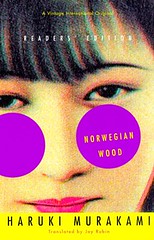
That book was a good, exciting read, and after reading more about his work on the Internet, I started pining for his other work. Norwegian Wood was the book that made Murakami a cultural sensation in Japan, and I finally got a copy last month from Lynn. The novel borrowed its name from the title of the John Lennon song.It differed from Dance Dance Dance in that it dealt less with the surreal and was more of a straightforward love story. Our hero is an average Japanese college student in the late '60s. Reeling from the death of his best friend, he finds comfort in the company of his best friend's girl, with whom he falls in love quite deeply. But the girl is very troubled and she goes away to get treatment for depression, while he is left to deal with the world outside. At university, he meets a dynamic young co-ed whose mission in life, it seemed, was to capture his heart.
The novel was surprisingly funny and simple. There are descriptions of typical dorm life, with odd roommates and weird characters, to which even I, who spent some time living in dorms in high school and college, could relate. He also pokes fun at would-be critics, with a girl asking the hero, "You aren't trying to talk like that Caulfield boy, are you?" perhaps realizing the comparisons the two would generate.
Most of the adventures are set in a Tokyo proudly displaying all the affectations of Western popular culture. We see our hero reading F. Scott Fitzgerald, taking a job at a record bar, picking up girls at bars, and listening to lots of Beatles records. It's a great backdrop for a book about love and loneliness.
Nick Hornby said, "The only reason trendy pop groups don't write songs like the Beatles did is that they can't." In a way, this is true as well for books like Norwegian Wood. It's not the easiest thing in the world to write about love, and about falling in love with a girl so deeply that it becomes heroic. We've seen a lot of people try and fail, and that is why the world is littered with banal pop songs and cheesy television shows and movies.
But Murakami definitely pulls it off, and quite brilliantly. He captures the loneliness and the happiness, the hope and the hopelessness that falling in love is all about. It is beautiful, heartbreaking, pitch-perfect, and the feeling stays with you for a while, even after it is over.
Just like a Beatles love song.